Specifications for Most Precious Blood Parish
- History of the Servers
- Altar Server Sodality (1858)
- Knights of the Altar
- Knights
- Knights of the Altar Society
- Purpose of the Society
- Qualifications
- General Rules
- Membership
- Method of Advancement
Nota Bene:
Parents, servers, and young men who wish to be a part of the server program, I will be introducing a new program for this parish called the Knights of the Altar Society. Today’s meeting is the new standard for the server program.
Much of this handout is taken directly from the pamphlet Knights of the Altar. Copyright, 1939, by Francis E. Benz, published by the Holy Cross Fathers.
The parts that are underlined are added regulations catered to the customs we wish to hold here at Most Precious Blood Parish.
History of the Servers
At a very important time in Jesus’ life, He accepted the services of a young boy. This young boy provided five loaves and two fish for that very momentous miracle with which Jesus launched his teaching on the Holy Eucharist. That Sacred Writers do not tell us the name of the young boy, only his deed, and his act of service. Altar servers also perform a great deed of service.
In past centuries, only priests or those ordained to the office of Acolyte were allowed beyond the Communion rail to assist in the Worship of God. The Order of Acolyte is a step toward the priesthood. It is the highest of the four minor orders, before a man seriously commits himself to the priesthood with the three major orders.
As seminaries grew, the Order of Acolyte became for the seminarian a step to the goal of Priesthood, and thus not as many remained Acolyte to assist priests in the Sacred Services. Therefore, the Church allowed lay men to perform the duties of that office.
As it became more necessary for men to work steady hours to fulfill their duties as fathers and breadwinners, and young men were called to serve in war time, boys were taught to take on the responsibilities of assisting the priests in their service with God.
Altar Server Sodality (1858)
St. Dominic Savio and another boy Joseph Bongiavanni were close companions at St John Bosco’s Oratory. Together they founded the Immaculate Conception Sodality for the purpose of frequenting Holy Communion. He and Joseph exchanged ideas for a special sodality for servers before Dominic’s death in 1857. Joseph shortly thereafter formed and served as the first president of an auxiliary of the Blessed Sacrament Sodality, the Knights of the Altar.
Don Bosco recorded in his publication, Catholic Letters that the new sodality of the Knights of the Altar served their first Mass on January 31, 1858, on the occasion of the feast day celebration of St. Francis de Sales. January 31 is now the feast day of St. John Bosco himself. Don Bosco celebrated the Mass and officially commissioned the Knights of the Altar in Divine Worship on February 2, 1858
Knights of the Altar -The United States (1939)
A diocesan priest from St. Paul, Minnesota, Reverend Francis E. Benz, formed the Knights of the Altar in the United States in September of 1938. The Archbishop approved it on March 28, 1939.
“The organization known as The Knights of the Altar, with the regulations governing it as set forth in the following draft as submitted by the founder, Reverend Francis E. Benz, has my approval. (signed) +John G. Murray, Archbishop of St. Paul.”
Knights
Why the name Knight? Medieval Knighthood, in the service of manor lords, calls forth such ideals as honor, loyalty, justice, chivalry, and respect for all. In the use of the term knight, the Altar Server is reminded of his duty to serve the Lord of lords with fidelity and honor, to treat others with respect and justice, and to live an upright personal life, defending always the rights of God and His Holy Church. In the names page and squire, the server is reminded again of the years of practice and study that went into the training of a knight and should consider with what devotion and perseverance he should attend to his own training in the service of the Altar. The chevalier was a traveling knight, which should remind the server that he should be ever traveling toward his heavenly goal.
Knights of the Altar Society
The Knights of the Altar is an organization of boys and men who serve Our Blessed Lord at His altar. It was organized in September 1938, in response to many requests from priests, brothers and nuns who felt the need of an organization that would aid them in solving the many problems they encounter from time to time in directing an altar boy society. These directors desired a central organization with rules and regulations to which they could conform and which would also serve as a clearing house for their many problems.
In forming the Knights of the Altar, studies were made of various local altar boy organizations. The successful and outstanding features were noted and used as a basis for this national society. Every feature was tried and tested and was found to be quite successful. Local directors may, at their discretion change certain details to suit the customs of their individual parishes. It is recommended, however, that they adhere as closely as possible to the general structure.
Purpose of the Society
(1) To form a worthy guard of honor to our Divine Eucharistic King in whose service we willingly assume the dignity and honor of becoming Knights of the Altar:
(2) To render faithful, reverent and edifying service to God by assisting His visible representatives, the Bishops and Priests, in offering the Holy Sacrifice of the Mass and in all other liturgical and devotional functions;
(3) To enkindle in the hearts of the faithful whom we represent at the altar, greater piety and devotion by reverently performing the duties of our holy office and by giving good example in our daily lives;
(4) Finally, to insure the continued and efficient function of the Knights of the Altar as a society by attending meetings and giving of our service to the Church.
Qualifications
It is of utmost importance to choose the right type of boys to serve at the altar. This fact cannot be stressed too much. Our Lord said to His Apostles, “You have not chosen Me, but I have chosen you.” So too with altar servers. The director chooses those who are to become servers. One may offer his services, but the final choice is to be made by the Knight Director. He who desires to become a server should prepare himself and be able to offer those qualifications which are necessary in one who aspires to become a member of the Knights of the Altar.
The Knight Director for Most Precious Blood is Mr. Eric Morey. The young men who aspire to be part of the Knights of the Altar Society must be first outstanding in prayer and character outside the communion rail before daring to pass into the sanctuary of the church. Parents must note, the Knights of the Altar Society should not be seen as a way of handing your child off so you don’t need to babysit them in the pews. He should want to serve, not be forced, and he should have an outstanding character and prayer life in the pew before he kneels next to his priest.
1) The Knight of the Altar, first of all, should be of superior character, pure of heart and soul. He should have a special love for Our Lord in the Blessed Sacrament. He should show this love in a practical way by often visiting Our Lord as He waits in the silence of the tabernacle and by receiving Him frequently in Holy Communion.
Indeed, no one should receive communion in a state of mortal sin. It is good that a child knows to cover their mouth and cross their arms over their chest to signify that they cannot receive His Most Sacred Flesh. When serving, however, it should be the rule of thumb that the server who serves be the exemplars for those in the congregation. Therefore, they must be ready to receive communion at every mass in which they serve.
That being said, it must be stated that there is an understanding whereby the server would not receive communion. First, if the child needs to eat before mass for medical reasons, or if the server forgot about the fast, he should not receive communion. Secondly, if the server is serving or present for his second mass (he can receive a second time), but it is understandable that he refrains from receiving a second time. Lastly, out of piety, it is understandable that a server refrains from communion to perform a Eucharistic fast so as to stir up a greater love and devotion for the Holy Eucharist.
It must be stressed that those who come to serve have a right to go to confession before mass. They must seek confession to have a pure soul ready to stand at Calvary, to serve at the altar. Therefore, it should be clearly noted that a server may cut the confessional line to serve mass with a most pure soul. (Cutting the confessional line is only for those who are about to serve. Those not serving must stand in line).
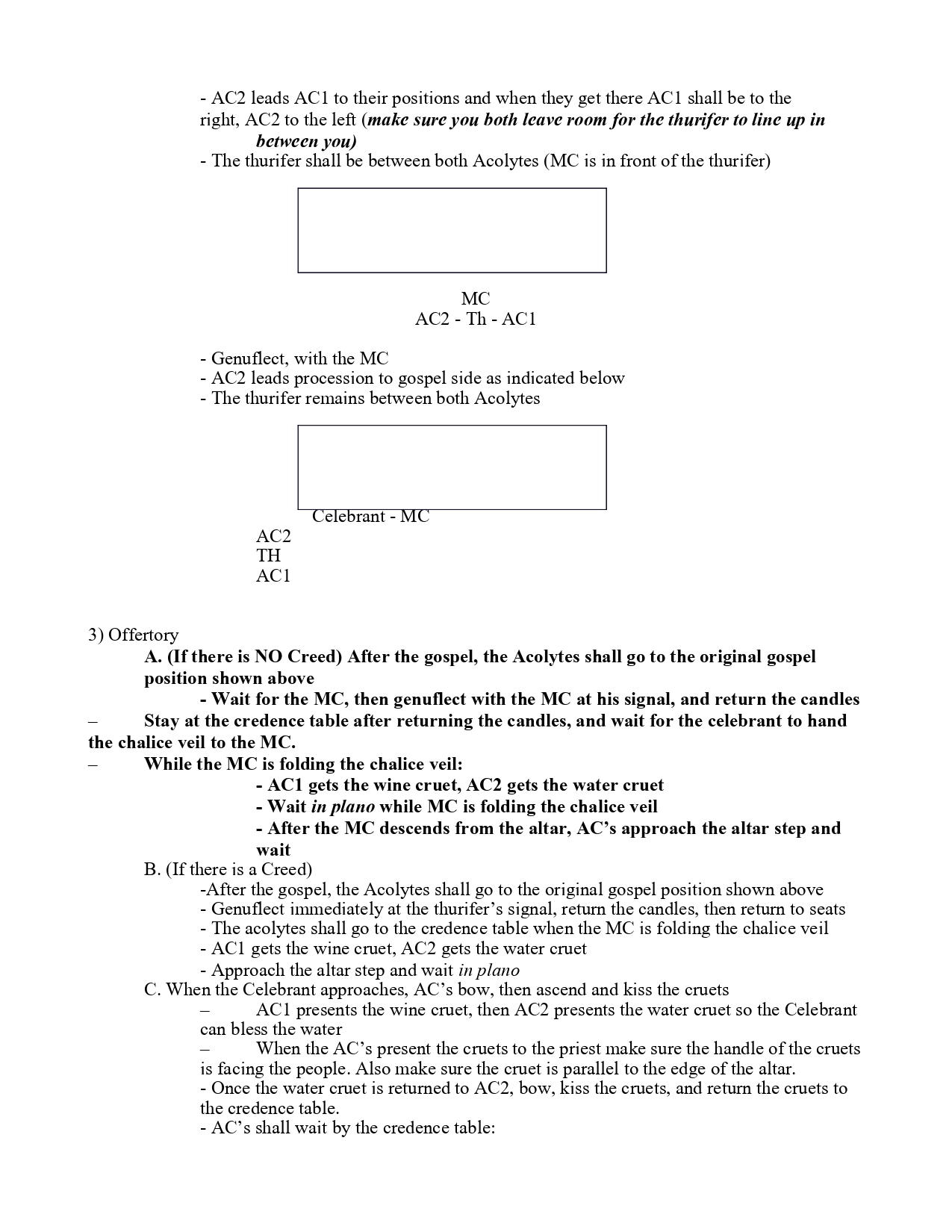
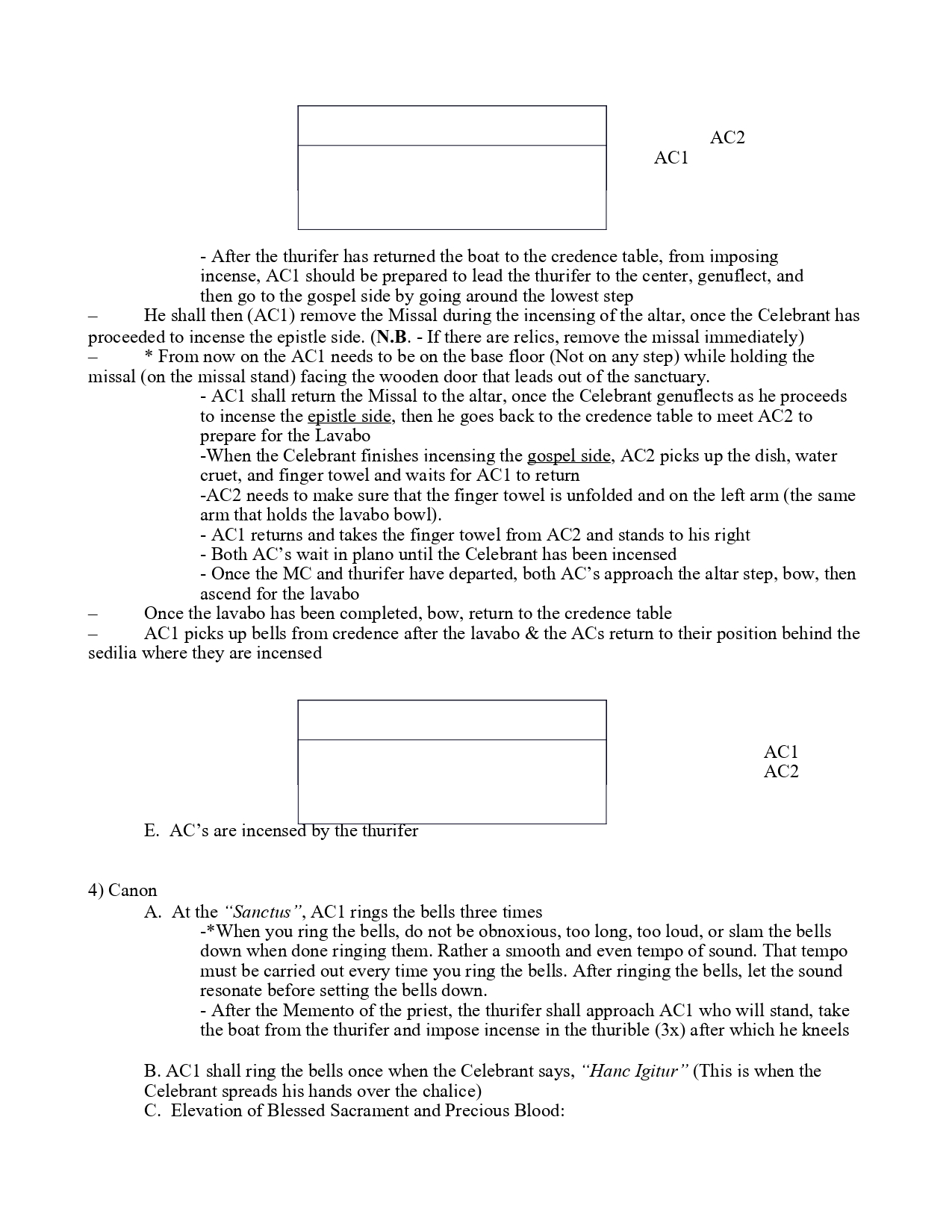
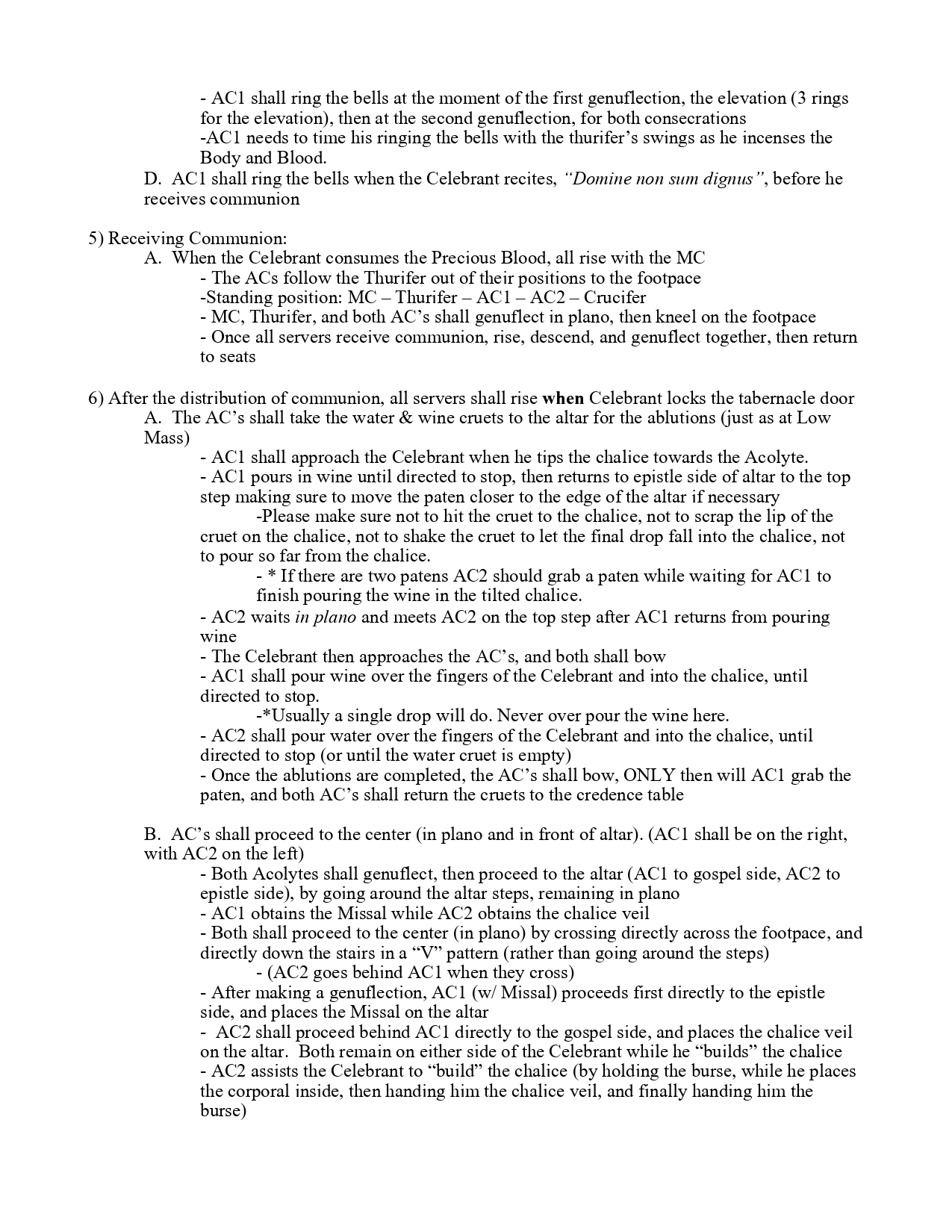
2) Secondly, the Knight must be intelligent. He must learn the Latin prayers and be able to recite them from memory. He must know and understand the movements around the altar and be without hesitancy in performing these actions.
He must be able to recite the Latin responses with clarity, as loud as the priest’s volume, and in unison with the other server (if there happens to be 2 servers). This does not mean that the server should shout or be obnoxious with his responses. The server’s voice may just not be as loud as the priest’s, and so it is okay if the people in the far back of the church cannot quite hear the server(s). That being said, the server must respond from the heart rather than mumble off Latin words merely memorized. He should, therefore, have a decent understanding of what he speaks on the altar.
3) The Knight must be trustworthy and reliable. When a server is, for example, scheduled to serve Mass, he must be on time. The Knight remembers what his Master sacrificed for him and any sacrifice he may be required to make is small in comparison. “Be on time” is an ironclad rule for any true Knight of the Altar.
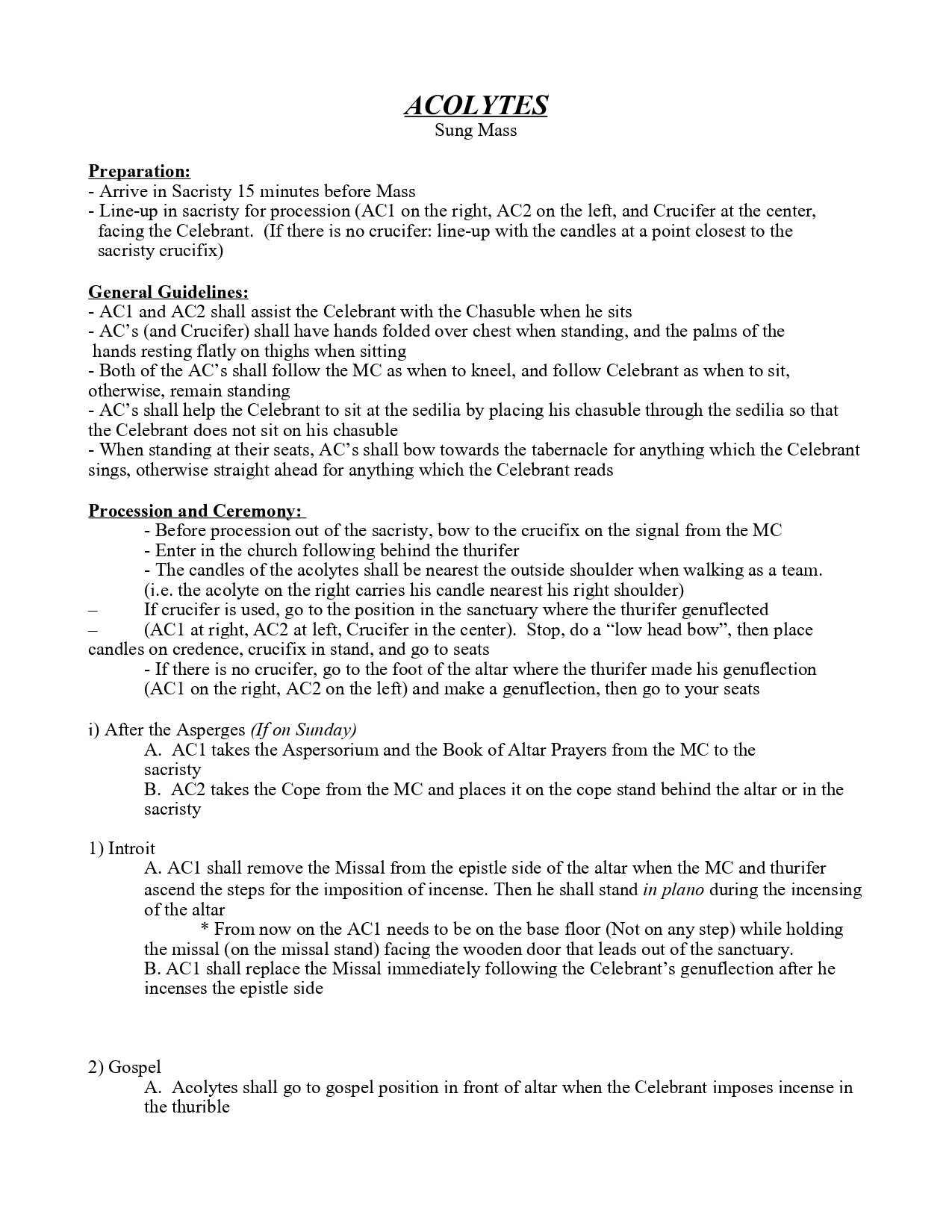
The server must to be in the sacristy 15 minutes before mass. The candles are to be lit 10 minutes before mass. The purpose for an early arrival is to find time to vest, to pray before mass, to set the credence table, to light the candles, and finally to be present in helping the priest get vested. The server needs to be ready to serve the priest not just at mass, but even before they process out. If the scheduled server hasn’t arrived 15 minutes before mass he will receive a penalty. (The penalty will be that this mass will not count to his advancement in rank). Furthermore, if the scheduled server hasn’t arrived, then 10 minutes before mass a replacement should be present in the sacristy ready to serve. 5 minutes before mass, if the scheduled server hasn’t arrived, he will be automatically replaced and not allowed to serve. Servers are expected to be prompt and leave catechism class on time to get to the sacristy to prepare for serving. Either one of the higher-ranking knights, the Knight Director, or one of the priests will be present to monitor arrival for serving.
When the server arrives to serve in the sacristy, he must maintain silence. There is to be no idle chit-chat, jokes, conversations about toys, games, sports. In many of the sacristies in Rome, the sign on the doors say silentio, rather than sacrastia. The Knights must speak, in whispers, on topics pertinent to serving.
4) Then, the Knight should always present a neat and clean appearance when performing his duties. He should never come to serve with casual, recreational clothing or footwear, or with hair long, styled, dyed, or uncombed, and he should always be clean shaven. (Hair must be trimmed or cut so that it doesn’t go below the collar. We want uniformity rather than someone standing out in the altar). No true knight of old would ever appear before his lord in disarray. So, too, a Knight of the Altar is extremely careful of his appearance when he comes into the presence of the Lord of lords. As the psalms say, “Worship the Lord in holy clothing” Psalm 96:9.
The Knight of the Altar Society has many ranks, so they will be required to dress based on the rank they hold: Apprentice, Page, Squire, Knight, Knight Commander, Grand Knight. The Apprentice is required to wear black dress shoes, black socks, black dress pants. The shirt may be of any color. Page and Squire are required to wear black dress shoes, black socks, black dress pants, a white button-down dress shirt, and a tie. The tie cannot be obnoxious, but rather tasteful. The Knight, Knight Commander, Chevalier, and Grand Knight are required to wear black dress shoes, black socks, black dress pants, a white button-down dress shirt, and a tie, and a black suit. Indeed, all servers have a right to wear what the Grand Knights wear. They cannot, however, dress down their requirements. Finally, this is the attire that all Knights of the Altar are required to wear when they come to mass, even if they are not.
It is understandable that the kids want to play outside and they may get their clothing dirty. It is okay for them to bring a change of clothes, but that is if they are actually planning to play outside. Changing into jeans or shorts just to hang out at church on Sunday is not permissible.
General Rules
All members and especially the officers shall be animated with zeal for the spiritual welfare of the whole society and its individual members. They should guard the rules and avoid dangers or abuses. They should strive to excel in piety, humility and fraternal charity-to be all around Christian gentlemen.
That a right order may be observed, all members should pay due respect and reverence to the Knight Director and to the Pastor as spiritual heads of the society as well as to all officers in charge according to their rank and to their fellow members according to seniority in age or in rank. This consideration in regard to seniority in age and membership is especially to be observed in regard to the election of officers.
If any officer should be prevented from fulfilling the duties of his office he must, as soon as possible, give notice to the Director or to the Supreme Grand Knight so that a substitute may be appointed or elected.
The officers and members should now and then converse with one another on the state of the society and either themselves or through the Supreme Grand Knight communicate to the Knight Director those things of which he ought to know. All members should work out differences in a spirit of kindness and charity. When problems arise, they should remember to follow the chain of command and refer it to the proper leader. If not sure, the Knight Director should be consulted.
All Knights of the Altar are expected to take an active part and a lively interest in recreational and social activities. Athletics, dramatics, sports, music, singing and various other activities shall be fostered and encouraged, thus giving every Knight of the Altar every opportunity to develop the best qualities of mind and heart. Every Knight of the Altar is, therefore, expected to give this matter due consideration and full cooperation as far as he is able and must learn to pool his individual interests with the interests of the majority, realizing that in unity there is strength, and success is realized only when all work together for the common end.
The hope for the servers is to also encourage friendship amongst the boys. There will be future events outside of altar server practice. Events like bowling, baseball, etc.
Membership
Whoever has been received into the Society remains a member even though he changes to another parish, school, or residence. In the latter case, he must try to comply with the rules and exercises of the Knights as well as circumstances permit.
When a Knight transfers from one parish to another where the Knights of the Altar is set up, he becomes a member of that unit upon the acceptance of his transfer by the Supreme Grand Knight with the approval of that Knight Director.
If any server breaks protocol, lacks maturity, has an unruly character he will be disciplined with a probation. A probation period of at least three months shall be incurred, whereby the server will not be scheduled to serve. This probation period may be prolonged at the discretion of the Knight Director or priest.
A Knight of the Altar retains his respective rank in the Society until he gives it up of his own accord, is promoted to a higher rank, is automatically dismissed by the rules of dismissal, or is dismissed by the Knight Director as unworthy.
Method of Advancement
Advancement to or in the ranks is absolutely in the hands of the Knight Director. Even though a Knight has sufficient service and knowledge entitling him to a higher rank, he must first of all obtain the consent of the Knight Director in writing. In this paper, he should include a) his current rank and the rank he is seeking, b) proof of service within his rank, c) what membership has done for him in the current rank, d) what specific, practical goals he has for himself in the next rank. This application is given to the Supreme Grand Knight who presents it to the Knight Director and to the Pastor (without the applicant being present).
Before advancing, each member must pass a knowledge test (rubrics and responses), as well as show proof of the service they performed in the previous rank. A paper listing the descriptions of service and the date each was performed is sufficient. If an altar serving assignment is done poorly or inattentively, it does not count toward the total of the required service. The Knight Director, or a Grand Knight he assigns, shall see to it that the servers are held accountable in this.
Knights may pass their tests by appearing before the director or someone appointed by him. The director should use caution and discretion in permitting them to advance sooner from one rank to another: age, time, need, etc. He should be careful that it is never used as a reward or bribe. (See also the rules of Admissions, p. 24)
Apprentice
- The Apprentice is a young man who wishes to join the Knights of the Altar Society. He is not really a full-fledged member but is merely on trial. His subsequent actions will prove to his director whether or not he is worthy of advancement and to be promoted as a Knight of the Altar.
Requirements: Received First Holy Communion.
During the time of the Apprentice, the following should be diligently performed or fulfilled:
- Learn the Rubrics for Torchbearer
- Study the Latin Responses
- Must learn the importance of making a 10 minutes thanksgiving after mass
How to Advance?
- The apprentice must attend 4 practices on how to serve as a torchbearer and cross bearer. (b. learning torchbearer and cross bearer is 4 practices in total, not 4 practices for each role).
Page
Requirements: The Apprentice who seeks to advance to Page must have proof that he has fulfilled the requirements of an Apprentice.
During the time of the Page, the following should be diligently performed or fulfilled:
- Learn the Rubrics for AC2 (Low Mass)
- Learn the Rubrics for AC1(Low Mass)
- Learn to Serve Low Mass alone
How to Advance?
- The Page must complete serving as a torchbearer 5 times and cross bearer 3 times
- If he fails to serve well as a torchbearer, (that is, if he makes many mistakes) that will not count as 1 of the 5 times as serving as a torchbearer. To advance in rank you must serve 5 times perfectly. The server’s performance will be monitored by the Knight Director, the Priest, or both.
- The Page must attend 4 practices on how to serve as AC 2
- The Page must attend 4 practices on how to serve as AC1
- The Page must attend 2 practices on how to serve both positions, if he were to serve alone.
- The Page must pass the Latin Response Test
- The Page must be able to make a 10 minutes thanksgiving after mass
Squire
Requirements: The Page who seeks to advance to Squire must have proof that he has fulfilled the requirements of a Page.
During the time of the Squire, the following should be diligently performed or fulfilled:
- Learn the Rubrics for AC2 (High Mass)
- Learn the Rubrics for AC1 (High Mass)
- Learn to entire Gloria in Excelsis Deo in full, as well as the parts were the priest must bow
- Learn Angelus in Latin
- Must fulfill a general task of charity at the church. (e.g. asking Mr. Neubauer (or the Knight Director or the priest) how they can help keep things clean in the church on Sunday. Maybe giving words of encouragement to a fellow server if they make a mistake. Essentially they need to strive to improve in their character as a server).
How to Advance?
- The Squire must complete serving as a AC2 (Low Mass) 5 times
- The Squire must complete serving as AC1 (Low Mass) 5 times
- Serving alone 3 times (Low Mass)
- If he fails to serve well as an Acolyte, (that is, if he makes many mistakes) that will not count as 1 of the 5 times as serving as an acolyte. To advance in rank you must serve 5 times (each role) perfectly. The server’s performance will be monitored by the Knight Director, the Priest, or both.
- The Squire must attend 4 practices on how to serve as AC2 for a High Mass
- The Squire must attend 4 practices on how to serve as AC1 for a High Mass
- The Squire must be able to make a 10 minutes thanksgiving after mass
Knight
- The Rank of Knight gives full membership in the Society of the Knights of the Altar.
Requirements: The Squire who seeks to advance to Knight must have proof that he has fulfilled the requirements of a Squire.
During the time of the Knight, the following should be diligently performed or fulfilled:
- Learn the Rubrics for Thurifer
- Learn the Credo in full, as well as the parts where the priest must bow
- Learn the Salve Regina in Latin
How to Advance?
- The Knight must complete serving as AC2 5 times (High Mass)
- The Knight must complete serving as AC1 5 times (High Mass)
- If he fails to serve well as either Acolyte, (that is, if he makes many mistakes) that will not count as 1 of the 5 times as serving as an Acolyte. To advance in rank you must serve 5 times perfectly. The server’s performance will be monitored by the Knight Director, the Priest, or both.
- The Knight must attend 4 practices on how to serve as Thurifer
- Pass the test, by reciting the Gloria in Excelsis Deo, while pointing out the parts where the priest bows his head.
- Pass the test by reciting the Angelus in Latin.
Knight Commander
Requirements: The Knight who seeks to advance to Knight Commander must have proof that he has fulfilled the requirements of a Knight.
During the time of the Knight Commander, the following should be diligently performed or fulfilled:
- Learn the Rubrics for MC and Benediction
- Learn the St Michael prayer in Latin
How to Advance?
- The Knight Commander must complete serving as a Thurifer 5 times
- If he fails to serve well as the Thurifer, (that is, if he makes many mistakes) that will not count as 1 of the 5 times as serving as an Thurifer. To advance in rank you must serve 5 times perfectly. The server’s performance will be monitored by the Knight Director, the Priest, or both.
- The Knight Commander must attend 4 practices on how to serve as MC
- The Knight Commander must attend 2 practice on how to serve for Benedition
- Pass the test, by reciting the Credo, while pointing out the parts where the priest bows his head.
- Pass the test by reciting the Salve Regina in Latin.
Grand Knight
Requirements: The Knight Commander who seeks to advance to Grand Knight must have proof that he has fulfilled the requirements of a Knight Commander.
During the time of the Grand Knight, the following should be diligently performed or fulfilled:
- The Grand Knight should continue in a faithful and diligent service.
- The Grand Knight should be ready to take charge for replacing those who are late to serve
- The Grand Knight should be ready to lead the server practices
- Learn the St Michael prayer in Latin
How to Advance?
- The Grand Knight must complete serving as a MC 5 times
- If he fails to serve well as the MC, (that is, if he makes many mistakes) that will not count as 1 of the 5 times as serving as the MC. To advance in rank you must serve 5 times perfectly. The server’s performance will be monitored by the Knight Director, the Priest, or both.
- The Grand Knight must complete serving at Benediction 2 times (Once as MC and once as Thurifer).
- The Grand Knight will need to lead server practices under the discretion of the Knight Director and the Priest.
- Pass the test, by reciting the St Michael prayer in Latin
Final Thoughts
Promotion Ceremonies will need to be organized by the Knight Director. The hope is that the Knights of the Altar will have a medal to wear while they serve. The medal is worn over the surplice. Rank may be displayed by the color of the cord.
The Server may overlap serving as any position more times than is required, and that is okay. More experience is what we are aiming for.
The guide requires that the server be 14 if they wish to be a squire, but it is at the discretion of the priests whether a younger server is advanced. The reason this is being pointed out is because it should, and will take much time for a server to make it to being a Grand Knight. This is okay. This process is meant to take time so as to build on the server. We want them invested with this for a long time rather than thinking they have accomplished and are done and fall into complacency and lack decorum after achieving Grand Knight.